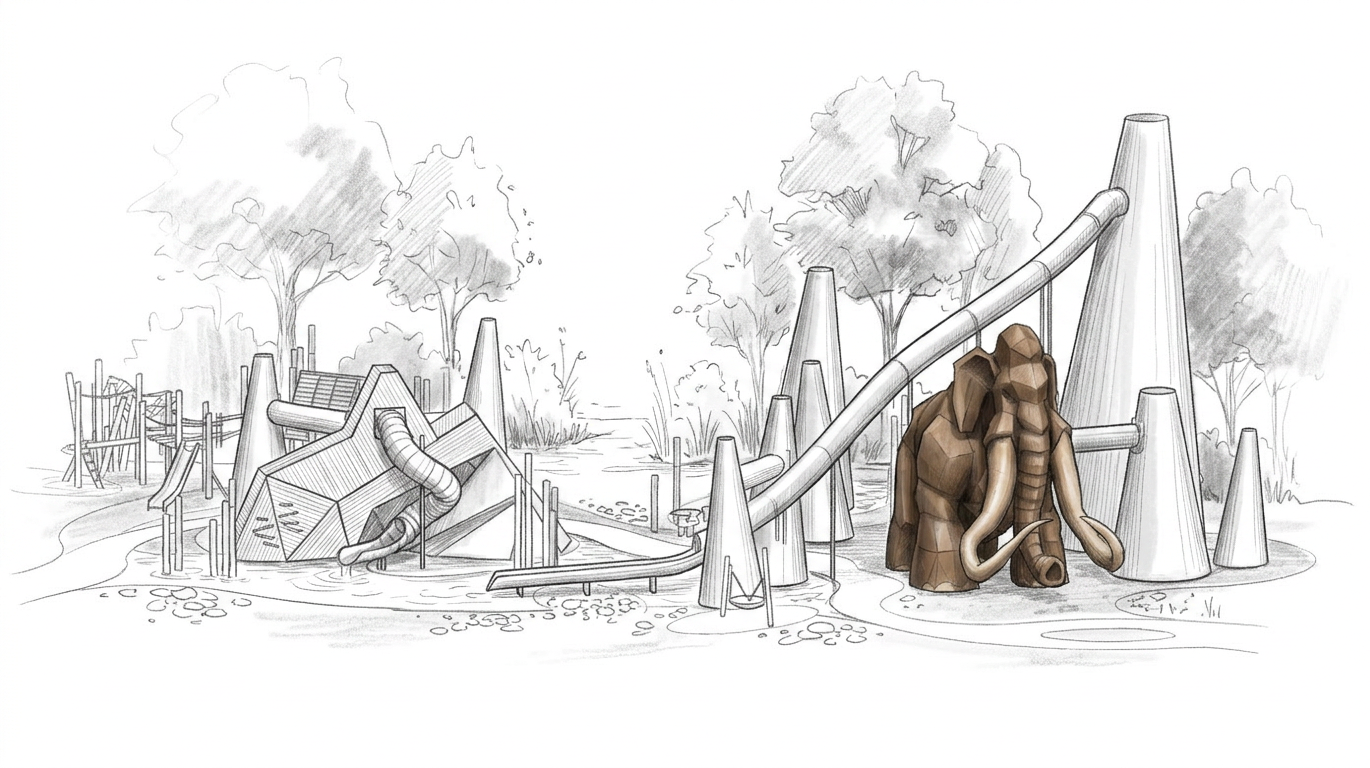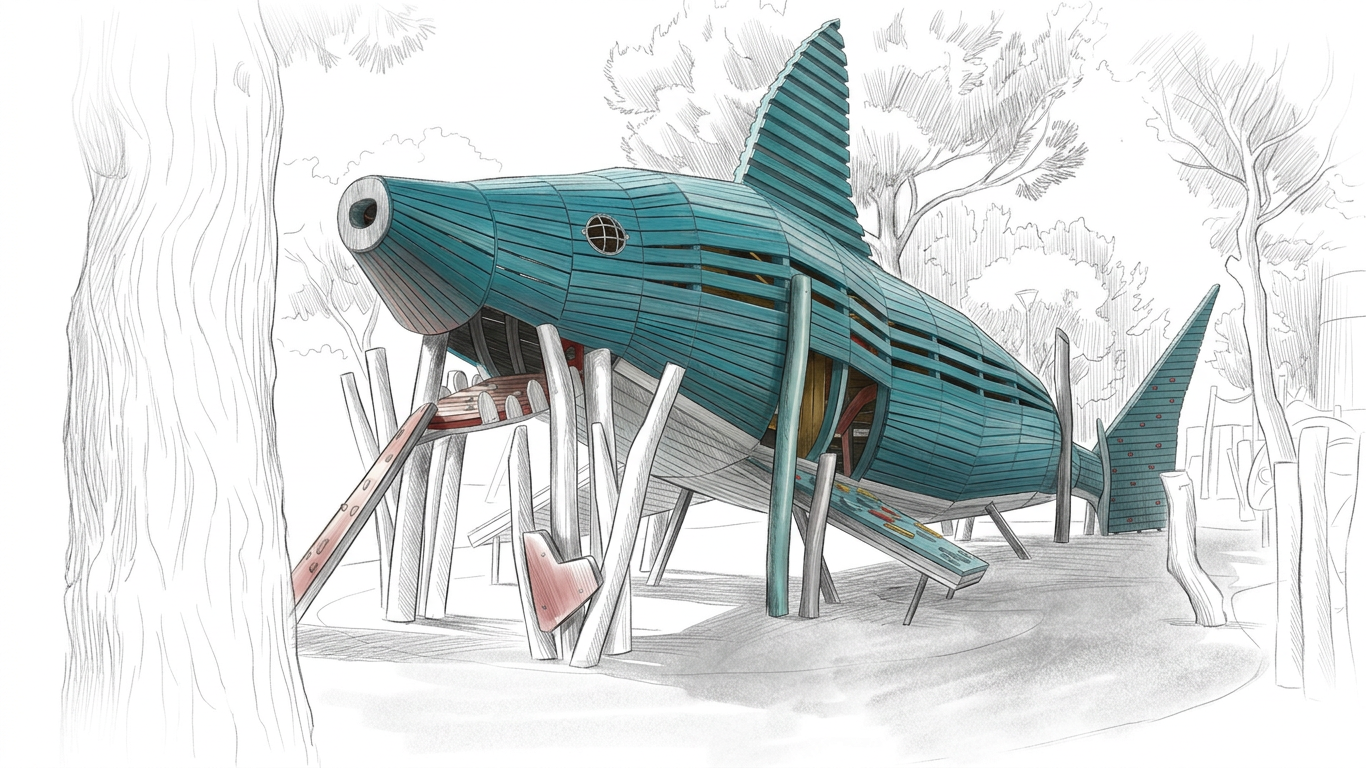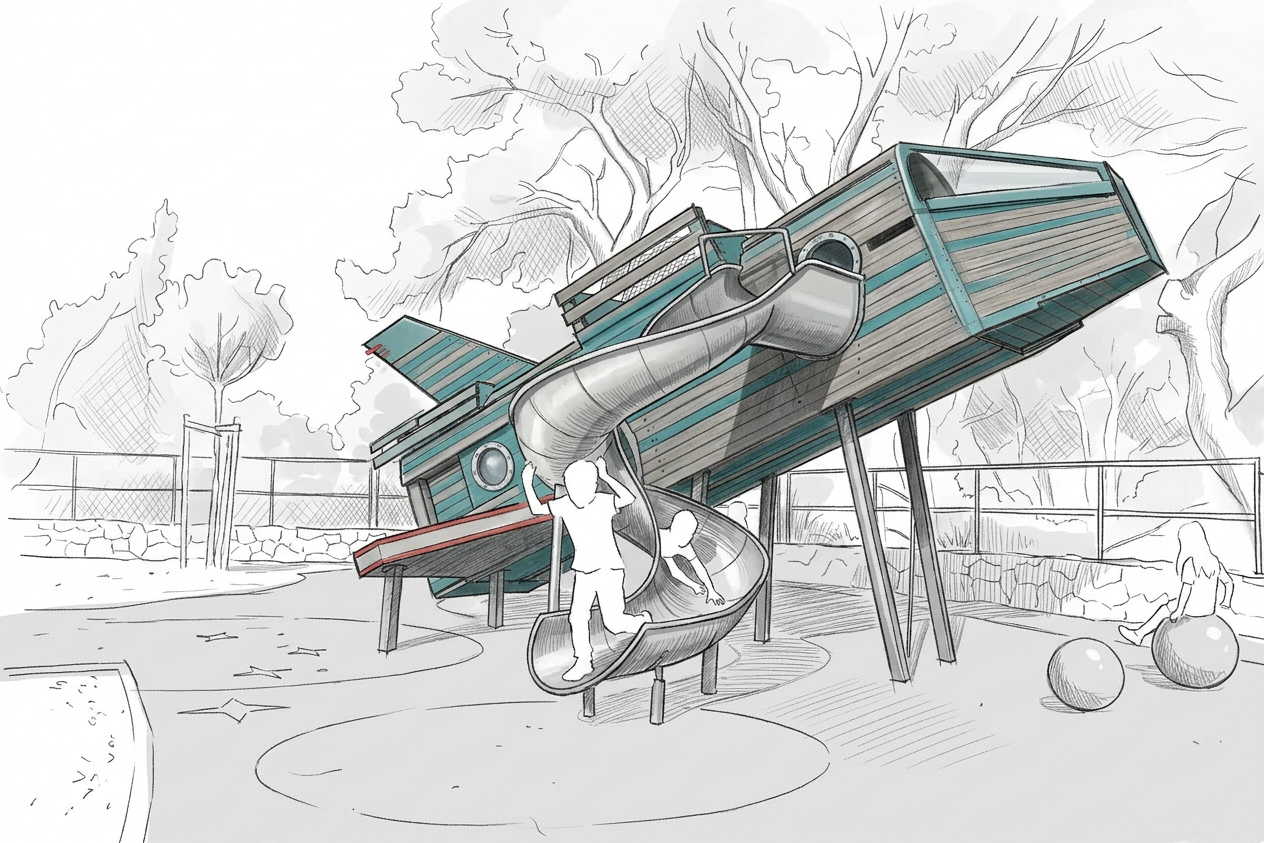
This project emerges from research, not form.
The starting point was not the playground typology. It was a question: how can space communicate complex ecological processes in a way that is understandable, experiential, and playful — all at once?
At the core of the project is the phenomenon of rising sea levels — a consequence of glacier melting and long-term ocean warming. Instead of abstract data or graphic representations, the aim was to translate this process into a spatial experience that can be understood through movement, play, and time spent within the environment.
Education not as a layer added on top. Education as the foundation of the design.
Make a global process felt at the scale of a child’s body.
Sea level rise spans centuries. A child spans a playground in seconds. The challenge was to make those two scales meet — without simplifying the science and without losing the play. To create a space where complex temporal and ecological processes become immediate, physical, and genuinely engaging.
The terrain is the lesson. Movement is the method.
The primary educational layer of the project is embedded within the terrain itself. The playground is shaped through subtle changes in elevation that follow the logic of contour lines — representing shifts in sea levels across time. These lines are not visual diagrams on a wall. They are physically integrated into the landscape, legible through walking, running, and play.
Illuminated contour lines mark the historical rise in sea levels over the past 200 years and project potential future increases over the next 300 years, creating a dynamic visual rhythm that shifts throughout the day. An abstract temporal process becomes a spatial experience. Children do not read about change — they cross it. By moving through different elevations, they are physically moving through time.
The blue crab is not a symbol. It’s a spatial argument.
The second key element of the project addresses shifts within marine ecosystems. The blue crab — a species expanding its habitat due to rising sea temperatures, increasingly present in regions where it was previously absent — is introduced not as a mascot or a graphic motif, but as a large-scale spatial installation.
Within the playground, the crab is reinterpreted as a structure that functions simultaneously as a climbing frame, a network of tunnels and passages, and an elevated platform for movement and exploration. Its exaggerated scale reflects the idea of expansion and growing presence — of a species, of a process, of change itself.
Placed within a field of vertical, reed-like elements, the installation becomes part of an environment that evokes the transitional zone between land and sea — a space in constant transformation. The crab is not explained. It is encountered.